The transitioning of our typical American suburban yard into a native garden began several years ago. Here are photos of some of my favorite Piedmont (Southeastern and NC) natives at home in what now has become a beautiful, low-maintenance paradise habitat. Featured here are some summer bloomers with additional ‘Field Notes.’
Hydrangea quercifolia


Field Notes: A beloved native shrub. If you have shady and ample space you must have Oakleaf hydrangea! It’s blooms are amazing and unlike hybrid or Asian hybrid varieties this is a true pollinator magnet with outstanding fall color. What other garden hydrangeas can do that?
Penstemon digitalis


Field Notes: A great all-round native perennial that is good for pollinators. Very adaptable and can handle part-sun. It will self sow slowly providing you with more plants. Does look best in a mass planting. Its bloom time is not notably long but the seed heads it produces are structurally interesting as well as fitting for a sensory garden due to their rattling when shaken. The basal foliage is also evergreen, acting as a ground cover when upright foliage is cut back. Penstemon is also disease and pest free, add that to its self propagation, and its one to use as a great filler to one’s garden design.
Phlox carolina


Field Notes: Phlox are winners in most every season. Phlox carolina has a lush bloom display and hangs on for many weeks. Trim back tops for more blooms later or just let it re-bloom as it likes. It can tolerate part-shade or full sun. Its foliage remains upright and its color palette blends well with other garden perennials like Penstemon, Amsonia, Echinacea and Coreopsis.
The more varieties of Phlox the better! Stretch the blooming throughout the season. This phlox, unlike Phlox divaricata and tender Phlox pilosa, seems to not be a favorite of bunnies.
Monarda


Field Notes: If you want to attract pollinators and more hummingbirds grow pockets of bee balm. Though I tend to enjoy more yellows, whites and purples in the garden I absolutely love the red of this Monarda didyma ‘Jacob Cline.’ It is very prone to powdery mildew and they do tend to need a bit of supplemental watering in dry spells but these factors do not affect its ability to bloom and bring in pollinators and hummingbirds.
Monarda will spread itself and can pop up as another plant a couple feet away. They make lovely tall patches of summer color that really fill in among other perennials. They can tolerate part-sun. I have them planted all around the garden just to see where they can cope and how they bloom. They can probably use supplemental watering during dry spells especially when they take on late day sun. They are still tough, will rebound, and even when foliage looks rough, the blooms still provide.


Monarda fistulosa ‘Claire Grace’ is a pink shade and starts blooming a little later than M. didyma but not by much. It can grow slightly taller, up to 3 1/2 feet and doesn’t re-bloom as much as M. didyma but this does require more observation on my part. I also think it doesn’t get powdery mildew like M. didyma but it could be the conditions where it’s growing our yard. It likes good air flow, part of its current conditions under our river birch tree.
Scutellaria incana


Field Notes: A member of the mint family, native to our area and the U.S., Scutellaria incana is not to be overlooked if you can find it. Pest free, tolerant of drought and heat, it seems to thrive best in part-sun to shady conditions. Can be planted as an individual plant or in a small group. This mint spreads slowly. The purple flowers grow on racemes and the plant doesn’t get larger than 3 feet high.
According to the NC State Extension Gardener Plant Toolbox, these “plants have bitter-tasting leaves so are usually ignored by deer and rabbits”. It attracts pollinators and is also a wildlife food source and larval host. I like to leave on its delicate seed heads for the rest of summer and fall as they provide food and a nice structural display for the garden.
Why do I use complicated Latin plant names? It’s the only way to be sure of what plant you’re talking about and working with! So many common names overlap and get confusing. They don’t truly indicate the species of the plant. Knowing the Latin name is both helpful and critical for knowing the behavior, value and outcomes of a plant in your garden.
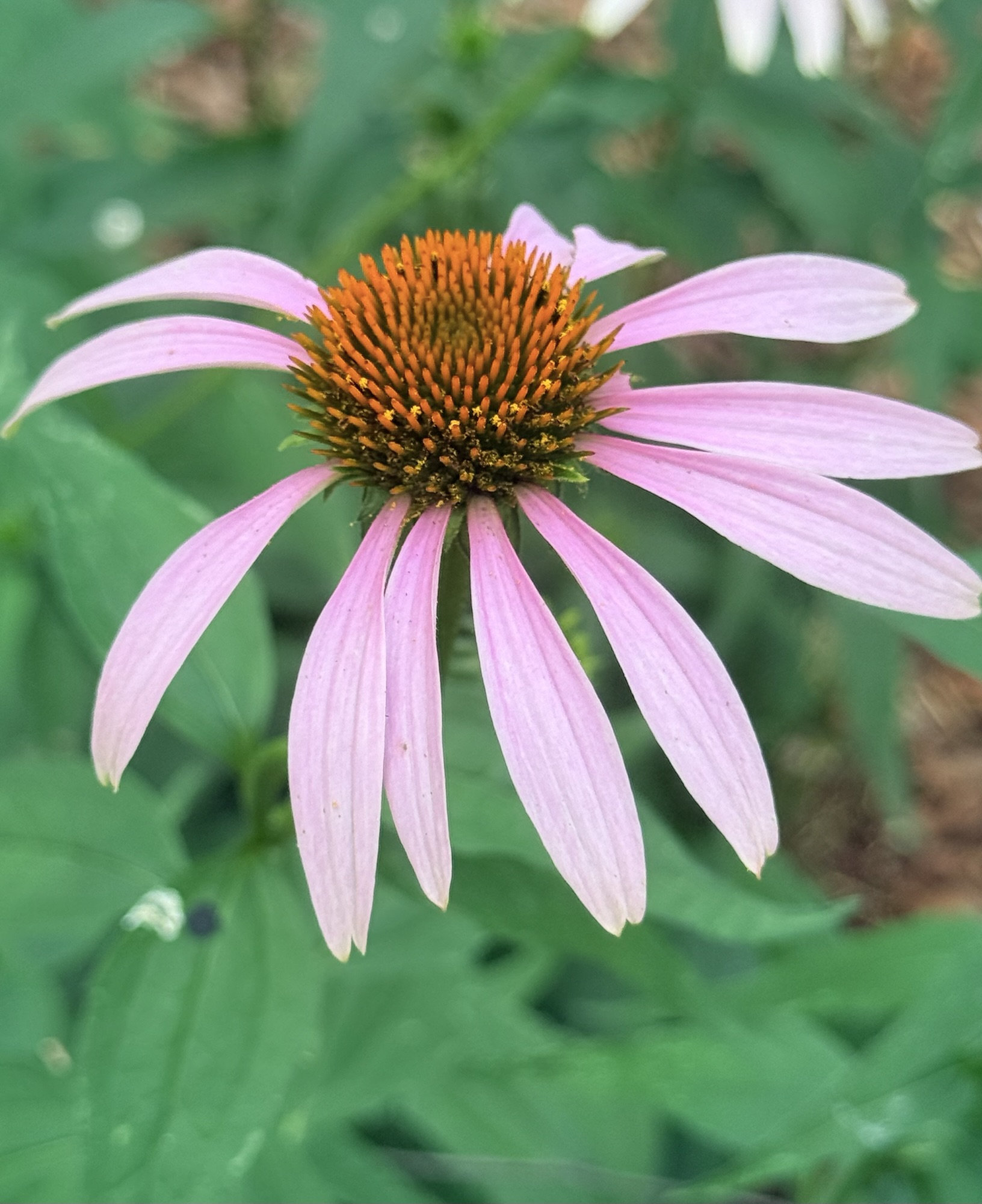
Echinacea
Field Notes: To some the rose is the quintessential garden flower but for me it’s the coneflower. Though under pressure in my garden because of possible mites and Aster yellows, I still couldn’t imagine it without them! They fit in perfectly with nearly any design. I love their signature orange cone centers and so do the finches as they perch and nibble the seed heads later in the season.


Coneflowers are an important part of the garden ecology. The flowers attract a variety of pollinators. The nectar is a food source for Silvery Checkerspot (Chlosyne nycteis) and Wavy-lined Emerald (Synchlora aerata) larvae. Songbirds dine on seeds and dead stems are used by stem-nesting bees. Long bred in a variety of colors, now bred with double blooms, I steer clear of these as double blooms on any native flower, produced from genetic mutations of reproductive parts, are typically sterile and produce little to no pollen. Always do some research before you shop 😉
I think of all the poor insects flying around looking for food and having to waste energy hitting up all the beautiful blooms of hybrids and non-natives that are pretty and enticing, but offer nothing. Consider this when you choose a plant for your garden. Does it have any nutritional value? Does it have substance?


Threadleaf coreopsis or Anacis verticillata


Field Notes: Coreopsis verticillata and Coreopsis ‘Zagreb’ (Anacis verticillata) are reliable summer bloomers in the garden. Often re-blooming a few times throughout summer into fall even if patchy. I love the wispy fine foliage that contrasts nicely with other broad leaf and aster family perennials.
It likes full sun for most blooms but can tolerate part sun. It is drought tolerant. C. verticillata blends well into the mid border while ‘Zagreb’ looks good at the front of the border, growing no more than 18 inches tall. Both look good en masse. Plant with other red or purple blooming perennials like Monarda didyma, Liatris, Echinacea or Agastache. It is not obviously susceptible to powdery mildew like other broad leaf Coreopsis.
Hypericum frondosum ‘Sunburst’


Field Notes: Loving full sun and tolerant of drought, ‘Sunburst’ St. Johns Wort is an excellent selection for the native garden. It’s foliage is dense, blue-green. It can retain its leaves in winter and further south in its range can be evergreen. Sunburst would make a great foundation shrub in full sun. Low maintenance and a pollinator magnet like you wouldn’t believe (see video below).
Rudbeckia hirta


Field Notes: A hearty native perennial in so many ways. Vibrant blooms; long-blooming; tough; resists chompers like rabbits because of prickly, hairy foliage; attracts insects of all sorts. Will gift itself in other parts of your yard as it spreads gently by seed.
Photos are informative and inspiring but something is lost for me, especially when it comes to something as alive as being outdoors in the garden. Therefore, enjoy this short video and take away a feeling!
For more information please visit our Native Garden Reference Links page here.
Struggling with native gardening or gardening in general? See my posts on how to handle garden frustrations and busts here.
Where to begin with a native garden? Start here.
More Year of Notable Natives here.

Leave a Reply