I’ve discussed my process for starting this New Native Bed from prep work of the intended planting area, to the requirements of my selection of plants, to finding real world inspiration. Finally here is a full list of what plants I’m using. We’ll continue to share with you how these plants grow and change as this bed fills out.

The Foundations
These are going to provide the main structure. I decided not to use any traditional looking evergreen shrubs. I decided against even a small tree because I wanted to allow as much light as possible. I also didn’t plant right up against the foundation of our house. I left this available as part walk way and may eventually fill in with some carex or sedge to line the walkway. This area also gets the least amount of sun.
Andropogen ternarius ‘Black Mountain’
This particular warm season grass is native to the southeastern US, was even ‘discovered’ in Black Mountain, NC, hence the name. It is a more compact version of splitbeard bluestem as it’s commonly known, growing up to three feet tall. It likes poor soil, sun and tolerates dry conditions.
This is a new plant for me. In the past I have tried native grasses in a couple of my borders with little success. I believe that this was mostly due to my inexperience and not really understanding how they’d fit into my plantings. I’m hoping new understanding might help this time around. But I am concerned by the part-sun exposure.
I chose it because it can handle poor soil and tough spots. It will provide structure in winter and in the fall will produce wispy, white seed heads. It will also stay a manageable size.
Here’s a link on more information.


Baptisia hybrid ‘Sunny Morning’
This variety is new to me yet I do have two Baptisia ‘Purple Smoke’ that I love, love.They are not necessarily the longest bloomers but the foliage through summer is soft green and lovely.
‘Sunny Morning’ as you might guess, blooms bright yellow in Spring. And according to my ‘What’s In Bloom’ calendar began in late April 2024 which is just after I planted them.
Even though Baptisia will lose not only all of its leaves but its entire form in the winter (it’s more like a tender perennial ), I consider it foundational in my border because it can grow up to 3 1/2 feet tall by 5 feet wide. I planted three.
Find out more about Baptisia varieties here in the Mt. Cuba Trials.


Yucca filamentosa ‘Bright Edge’
This is the main ‘evergreen’ in my border, planted mid ground, even up to the front. They are ‘scattered’ along with the grasses across the border, while the Baptisia sit in a staggered group in the middle- back of the border.
I chose it because its foliage will hold through the winter, it’s drought tolerant, clay tolerant and doesn’t grow too big. In fact it will be wider (up to 36″) than taller (up to 18″). They can be hidden in summer by other foliage but come winter they will get to be the showstopper. In spring the bright, yellow edges of their floppy, dagger fronds, will look beautifully alongside the blooming Baptisia.
For more information look here.
Mid- ground Perennials
These perennials will fill into most areas at mid height. They may obscure the foundations with their textures and seasonal color but will fade away or remain as seed heads throughout the winter.
Echinacea purpurea ‘Fragrant Angel’
I find echinacea to be really hearty in the garden. It is the quintessential summer bloomer and it’s variety of color found across the cultivars helps to integrate it into any color palette of your choosing. This is a cultivar that is new to me. It was a top performer in the Mt. Cuba coneflower trials several years ago and scored high in attracting pollinators. It is also a beautiful white flower.
Check out those coneflower trials here in the link to my reference page.


Echinacea purpurea ‘Magnus’
Blooming June to August this echinacea cultivar will have large (up to 5 inch) purple blooms. Its coneheads left on over winter should provide a food source for goldfinches and other birds and add visual interest to the ‘natural’ look of this garden bed area. Though the colorful petals are gone all the echinacea together should make a nice show in years to come as the garden matures.
Rudbeckia fulgida
Also known as orange coneflower, this Rudbeckia has a modest height of 2-3 feet. It will bloom from July to October. It adapts to clay soil, moist soils and some drought but prefers good air circulation. It’s a slow rhizomous spreader and a prolific bloomer. Though I have grown other varieties of Rudbeckia, this plant is new to me. I have planted two next to each other and will probably wish that I had purchased more.


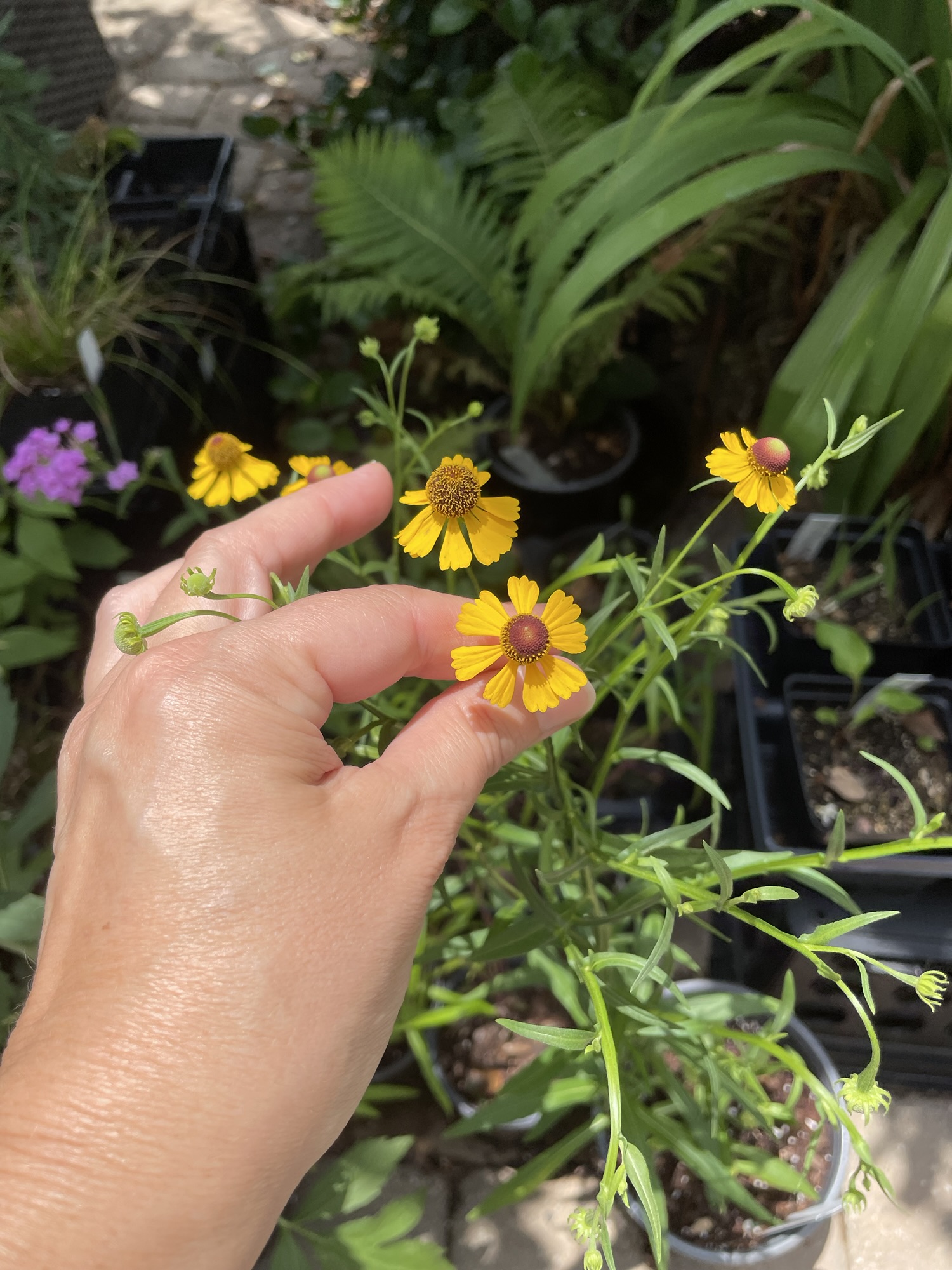
Helenium flexuosum
The Mt. Cuba Center trail study says that Helenium flexuosum, aka purple-headed sneezeweed, has, “garnet-colored cones and strongly reflexed, maize-yellow petals. Individual flowers are somewhat diminutive, but what they lack in size, they more than make up for in quantity.” It is a mid-summer to early fall bloomer, can handle some average to wet soil and should stay under 3 feet. It may need staking though. It’s my first time growing this, so we’ll find out!
Looking for more info on Heleniums? Check out the Mt. Cuba Center trial garden report here.
Liatris
I have planted three varieties and so far two are coming up this spring but I’m only sure of one, Liatris microcephala, aka smallhead blazing star, and this is because I just transplanted it from somewhere else in my yard. It will bloom mid-summer, tolerates dry soil and should remain smaller at under 2 feet for a Liatris.
The other Liatris is either Liatris spicata or Liatris ‘Kobold’. I planted them in the same area, at the same time and my goal was to grow all three varieties and compare their performance. I ordered Liatris ‘Kobold’ mail order and it did very well but I left it too long without planting it and may have over-watered it, so lost all but one ‘Kobold’ which I finally planted in C2 last fall. As the season progresses I hope that I can identify if it is the survivor or not.


Liatris spicata, dense blazing star, is a larger liatris growing up to 3-4 feet high. This is my first time growing this Liatris if it is, in fact, still there. The L. microcephala that I planted last summer wasn’t doing so well in its location so I moved it this spring to C2 in hopes that it will prefer its new home and round out my little block of Liatris which seems like it’s just two plants.
Penstemon digitalis ‘Husker Red’
A long time favorite, native cultivar growing in my garden, ‘Husker Red’ is a solid, reliable and beautiful semi- evergreen perennial. It is a late spring bloomer with white, pink flowers on tall burgundy stems. The leaves, both burgundy in spring and deep green as it matures ,add rich color that contrasts nicely with other green foliage. It re-seeds itself slowly and I was able to dig up and transplant several of these plantlets to C2. To note: C2 is a new bed but it also connects into an established bed that runs across the front of our home (A2). Penstemon was the perennial that I chose to join the two beds as they now overlap from A2 to C2, or the front of the house to the side.
Penstemon would be a first choice plant for a new native garden in my book. It’s easily adaptable with very low maintenance and also fills in that late spring, early summer bloom gap (which isn’t at gap at all if you plant this one). It attracts bees and other pollinators as well as hummingbirds. The color of its foliage also adds some interest for design in the native garden. It grows 2-3 feet tall with the blooms adding that extra height with a 1-2 foot spread.


Amsonia hubrechtii
An amsonia with wispy needle-like leaves and blue star-shaped flowers for which all the Amsonia are known. Mt. Cuba Center also has a plant trial for these beautiful bluestars found mostly in the US and Mexico. A true continental native yet so few are seen in the landscape.
A. hubrechtii will also offer some lovely golden-yellow color in the fall before it loses its foliage. This is my first time growing A. hubrechtii, though I have had A. tabernaemontana in my garden for years now and I am always delighted by its true blue flowers, a rarity in the garden, in spring. So far it has been an easy to care for plant. It may take a couple years for A. hubrechtii to mature and show off its well-rounded beauty, but I think that anticipation makes it all the more special.


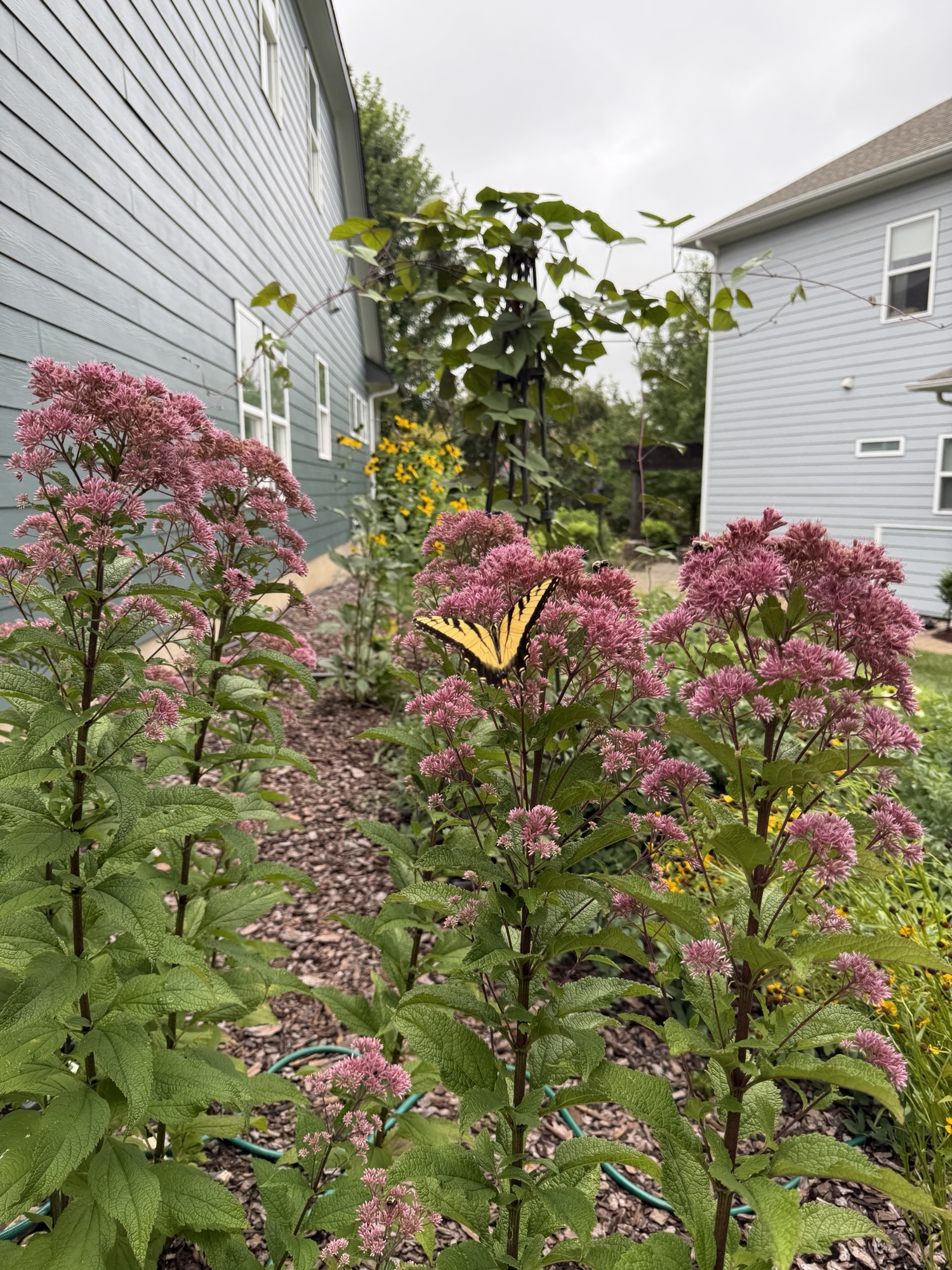
Eutrochium dubium ‘Little Joe’
This is a more compact version of the straight species of Joe-Pye Weed. Its true parentage is unknown and it has been patented. It tolerates seasonally wet and dry locations and I’ve had them growing by another downspout in my yard with success. Their mauve flowers are pollinator magnets and their small form (3-4 feet high) make them more suitable for a small yard. Their smaller growth also keeps them from flopping over. They often come up late from the ground in spring so don’t be dismayed if they haven’t arrived when everything else has.


Chelone glabra
This white turtlehead flower is a late summer bloomer also. I have it planted near the downspout of C2 along with the little joe-pye weed. It can tolerate periods of drought but also moist soils which tends to typify the weather in the NC Piedmont. There’s either a ton of rain or none at all. That’s why these native plants can survive and do well in otherwise difficult growing locations. It does prefer moist sites in sun or in dappled shade.
C. glabra is also an important insect host plant providing larval food for the orange and brown Baltimore checkerspot butterfly. Pollinators in general love this plant and even hummingbirds.
Coreopsis verticillata
Threadleaf coreopsis is another native perennial with many cultivars. It has bright, beautiful, yellow flowers that keep coming most of summer on tall, lanky stems. It is of note that you can sheer down the tops for a fall rebloom and to keep the plant tidier.
Its threadleaf foliage is sparser than some cultivars but it seems to mix well with echinacea and phlox. What is going into C2 has been transplanted and divided but I think they’ll stay fast and do well. They can tolerate poor soils, heat, humidity and drought. Coreopsis verticillata ‘Zagreb’ is another variety that’s more compact but also reliable. I would have used it in this bed (and may still do) as another foreground plant but I neither wanted to dig and divide or purchase for this year.


Asclepias tuberosa
With bright, rich, orange, early summer blooms this butterfly weed was a must for my native garden bed. I had the perfect place in mind and sketched for five of these plants but it just isn’t happening this year. The plants I bought and the seeds I planted have disappeared. I’ve never had a plant more difficult to grow but I won’t give up. Their place has been seeded with zinnias in the meantime. Though zinnias are not native to the US, they are a garden delight. They’re tough and they bring the color and the pollinators.
Salvia ‘Amistad’
A perennial salvia that is winter hardy in our Zone 8. Not a native plant to our area, but a profuse, long blooming, shrubby grower of up to five feet tall, ‘Amistad’ salvia, also known as friendship salvia, is a relatively new hybrid. With “large, rich royal purple flowers adorned with nearly black calyces,” according to Gardenia.net, it is a very versatile plant in the garden if you have the space. It begins blooming is early summer and continues until the first frosts. It won an Award of Garden Merit from the Royal Horticultural Society (RHS).


Solidago rugosa ‘Fireworks’
Transplanted this spring to C2 I hope that ‘Fireworks’ will contrast nicely with the lovely purple blooms of ‘October Skies’ in the early fall. This Solidago, or goldenrod, will grow to 3-4 feet in full sun. It likes medium to wet soils. For the last couple years I’ve had it in dry, partly shaded soil, only because I didn’t really have another good place for it and still wanted to pair it with some fall blooming purple asters. It survived and bloomed there but I think it’ll be much happier where it is now.
Foreground perennials
Smaller plants in height including evergreen or semi-evergreen groundcovers. Flowering and also providing wildlife and insect value.
Symphyotrichum oblongifolium ‘October Skies’
‘October Skies’ grows more compact than the straight species, typically growing up to 18 inches tall. It features attractive, deep sky blue, daisy-like flowers with yellow center disks in late summer to early fall. Though a very easy to care for plant, it may need to be divided. It tolerates poor soils, sandy or clay, and will be relatively drought tolerant.
Members of the genus Symphyotrichum support a variety of specialized bees. This is a profuse bloomer as I have found also with Symphyotrichum oblongifolium ‘Raydon’s Favorite’ another compact version of the species growing 2-3 feet high and wide. They truly are beautiful late bloomers, coming on with such fresh, outstanding color when all else is tired and weary. Though their foliage ain’t much to look at, you gotta have asters! They also pair well with Rudbeckia and native grasses like Muhlenbergia capillaris, pink muhly grass.


Phlox pilosa
This is a ‘not new to me’ plant but I’m beginning to get to know it a little differently this year. With lovely pink flowers, this compact native downy phlox is a very long bloomer and it’s already started (first week of April this year). According to my ‘What’s in Bloom’ database for the year of 2023 it bloomed April into mid-June. Now that blooming really fills a blooming time gap for me. If you haven’t already noticed there are many mid-summer to fall bloomers represented in C2 but not as many late spring and early summer. P. pilosa will have no problem with doing that as it begins to establish itself. I planted five that I pulled up and repotted from my original plants.
I say ‘pull up’ because you really are going to have to start pulling it up and maintaining it if it likes where it is. It’s the one plant that I have found growing in the fescue lawn if that says anything. It is easy to pull up though. As this is a plant-human relationship you are going to have to decide how much work you want to put in to keep it maintained. Is it worth the work? Here are some reasons to give it a try.
What I like about its bloom time, so do insects, including a range of bees, butterflies, moths and even hummingbirds (yet I have not seen the later happen yet). This means that it fills a food source gap for them, while waiting on other perennials to come into play. It is also an insect host plant and has been used for medicinal purposes by Native Americans. Be mindful that it will be valued and browsed by deer and rabbits too.
Another reason to try it is its loveliness. The pink shade of its little tubular flowers is cheery. The foliage stands up and is dense and compact growing just under two feet. When it rains hard, it takes a beating but P. pilosa will look fresh again in a day. It benefits from a good top side trim after flowering to keep it looking best and you will need to pull back roots from other perennial neighbors if P. pilosa likes where it is and wants to expand.


Phlox sublata
Another phlox that will expand by shallow roots if it feels loved is P. sublata. I have three varieties that have expanded over the years so I have dug parts from them and moved them around the yard to cover some of the blank mulch and bare ground space. It is mostly evergreen whereas P. pilosa is partly-evergreen. It grows in a clump that looks and spreads like moss which is why it is also called moss phlox. It gets six inches tall and 2-3 feet wide so fits really well in the foreground of the bed while also enjoying full sun. Not many native ground covers can take full hot southern sun.
The shades of P. sublata always blend so well together like ‘Emerald Blue’, ‘Purple Beauty’ and ‘Scarlet Flame.’ These are some of the first spring bloomers in my garden beginning in March for Zone 8. . They will continue to bloom en masse for at least 3-4 weeks and then pop singular blooms for a little while longer. I can’t think of too many plants easier to grow and with so few issues. I don’t know if it’s of great value to pollinators but the insects that live underground seems to co-habitat well with it. I haven’t noticed that rabbits like it as much as they enjoy other phlox varieties especially P. divaricata.
Marshallia obovata
M. obovata, also known as Piedmont Barbara’s Buttons, was the 2009 NC Wildflower of the Year pick for 2009. In fact there are a few plants chosen for my new native bed (also called C2) that received this designation sponsored by the NC Botanical Garden with support from the Garden Club of North Carolina.
This plant is a low growing, clumping evergreen that likes full sun. So it doesn’t really fall into the category of ground covers but I’m hoping that that’s what it will do in one little block of C2. All of what I’ve planted and am growing are from seeds that I purchased from the NC Botanical Garden. The seeds require cold stratification so I started them outdoors in the fall of 2023. When I planted three plantlets in Fall 2024 they were tiny things but hung in there all winter, their basal foliage remaining evergreen, and are still growing.
As they mature they’ll shoot up straight stems for small clusters of white flowers in mid- late spring. I’ve planted them next to lemon thyme and their white flower blooming should overlap for a lovely display while also drawing in pollinators.

Thymus x citriodus
Not native. A Bonnie Plant from Lowes. It probably has its origins in Europe; is a member of the mint family; has medicinal and culinary value; is adorned by pollinators. Liking full sun this low growing herb will spread 2-3 feet wide by up to 12 inches tall with fragrant blooms in late spring and the most heavenly aromatic foliage all year round. A truly divine aroma that should be experienced by all.
I like to grow herbs and are usually incorporating them into the landscape. I love preparing meals with fresh herbs and freshly dried herbs especially parsley and dill. I keep this lemon thyme mostly just to have on hand to smell. I haven’t used it in cooking or teas and not yet for bath and beauty but it is there for the day and to enjoy everyday. The insects agree.
Background and Vertical Accents
This new native bed sits off of the corner in a bulky curve along the NW side of our two-story house. It juts out like a sore thumb and the wall of the house seems rather bare behind it. My husband wants to put a small tree in the space to fill the frame vertically and I get that instinct. But a small tree would shade a good portion of the available sun that I am currently trying to maximize on. My solution is a 7 foot obelisk trellis off set at just the right spot in the bed.
Here I can add extra vertical interest, use annual vines or even veg to soften it or give it bulk and stature. I can change it up every year and it doesn’t even have to be native because this is a mostly native bed. When my Baptisia fill in they will also add bulk and foundation and the trellis can sit towards the side or behind, depending on your angle of view, and display flowers from above. But I’ve also added taller native perennials ‘new to me’ to try out as background beauties.


Eryngium yuccifolium
Commonly known as rattlesnake master, this native US, herbaceous perennial is a member of the Apiaceae (carrot) family. It can grow up to five feet high and 2-3 feet wide. It’s leaves resemble a yucca plant and have a thorny edge to them. What is most striking are its unusual flowerheads that appear like spiky white balls on long stems above the base foliage. It should be an eye catcher if it does well in its placement in C2. It’s the kind of perennial that I wouldn’t be able to grow for long if I were to plant a small tree.
Rattlesnake master does best in full sun with moist soil but has even adapted to dry, rocky soils with low organic matter. Will it do well with the sun exposure here? I’m not sure but I’m going to try it out. I also have a few plantlets that I’ve grown from seed that I purchased from the NC Botanical Gardens. So this plant may find another spot in my garden in the future. It was also chosen as the 2016 NC Wildflower of the Year and rated as one of Debbie Roos’ top pollinator plants in her ‘Pollinator Paradise Garden,’ a demonstration garden in Pittsboro, NC.
Find more info on this plant here.
Rudbeckia laciniata ‘Herbstsonne’
Another ‘new to me’ herbaceous perennial is the autumn sun coneflower or cut-leaf sunflower, as this variety is known. It grows from 4-7 feet tall and 3-5 feet wide, so quite a robust, clump forming plant. It is said to be loved by a multitude of pollinators and goldfinches, blooming from 4-6 weeks from the end of summer into fall, and works well at the back of the border, which is where I have planted it. The Royal Horticultural Society gave it an Award of Garden Merit in 2002, if we want to talk about accolades. It is noted to be ‘well behaved’ but can form a large clump over time.


Labab purpureus
Purple hyacinth bean as it is commonly known, is non-native twining vine that originates from Africa, Asia and the Caribbean. The seeds that I purchased have been been grown in this country since at least 1802 and are the same variety grown at Monticello, Thomas Jefferson’s homestead in Virginia. It is treated as an ornamental vine here with deep purple-green stems, pretty pink flowers and 3 inch purple pea pods. According to Southern Exposure Seed Exchange, the tender leaves, flowers and pods are edible.

This vine is intended for my obelisk trellis and is something that I’ve grown before. In full sun, the colors and flowers are beautiful. I think they’ll nicely compliment the late summer yellows, oranges, mauves and purple that will also be on show. It’s still early to direct sow the seeds as we’re still experiencing chilly temps at night but I do know from experience that this vine is easy to grow from seed and is a hearty grower.
Annuals and bulbs
The purple hyacinth bean that I’m planning to grow is also an annual. Sometimes these non-native annuals fill in a gap where we’re trying to figure out what other perennial will grow in its location, or we’re waiting to source a specific perennial, or we just want to leave a spot open in our bed to mix up the color or texture each year.


Zinnias
Just a fun, easy to grow, sun loving, pollinator and bird magnet, flowering plant. They bloom until frost and there are so many varieties and colors available. It can reseed itself so don’t be surprised if you find them growing in other parts of your yard next year. This year I am trying out Raspberry Sorbet (Zinnia elegans) which are raspberry colored, double blossoms on tall 3-4 feet stalks. They will add a nice jewel tone analogous to the jewel tones of the purple hyacinth bean vine and the Amistad Salvia.


Ocimum basilicum
Queenette True Thai Basil is a tropical looking, exotic flavored basil that is ‘new to me’. I’ve grown herbs. I’ve grown basil but this exact variety is a new one that I happened upon on a gardener’s blog. She scattered seeds along with zinnias to fill in some spots in her perennial garden bed. It looked fantastic! The thought of also filling in space with an edible appeals to me also. The foliage is compact growing no more than 1 1/2 feet high by 1 foot wide with green leaves on purple stems and sprouting lovely violet flowers that I’m sure will draw in the pollinators. I directly seeded these into my plot, I just hope I didn’t do it too soon as we have had a few nights dip below 50 degrees F, it is April after all.
Narcissus sp.
I happen to love the bright cherry faces of daffodils in early spring though they are not native to our continent and can naturalize and spread. I’m pretty sure they don’t offer anything in the way of spring nectar for insects either. My solution is to plant and include native spring perennials and ground covers alongside that do.


If you have the energy and passion for it, variety and diversity are key in the garden for wildlife, insects underground and pollinators above. It also brings aesthetic interest year round as we take another spin around the sun. If you have a smaller space fewer species and varieties can work just as well if chosen wisely with a little research which I’d recommend with any size garden.
Gardening is incredibly rewarding for body and mind. And if you’re adding even a little bit of something positive back to the environment then maybe it’s good for the soul too.
“A good garden is always part of a good life.”
Monty Don, gardener, author, presenter
Have you been thinking about starting a little patch for pollinators in your garden? Are you looking to just down-size the grass and go bigger with natives to boost your property’s ecological value? If so, check out how I began to do just that here in A New Native Bed: Patience and Planning and here in A New Native Bed: Selection Process. I hope this information helps in planning your borders and beds. Also see my Native Garden Reference Links here, it’s being updated all the time.





Leave a Reply to Fall Shots: C2 – SevernistaCancel reply